

Looking for the best Baby Soap in Ghana? Every baby soap on the shelf says “mild” and “gentle.” None of that is regulated language. If your baby’s skin flares after bath time, the soap is the first thing worth checking — and the difference between bars comes down to three things most parents never get told about.
Why baby skin needs different soap
A newborn’s skin is significantly thinner than an adult’s, and the acid mantle — the slightly acidic film that keeps moisture in and irritants out — is still developing through the first year. That’s why the family soap that’s perfectly fine on you can leave a baby tight, flaky, itchy, or broken out.
This isn’t a fringe problem. According to the American Academy of Dermatology, eczema affects up to 25% of children, and an estimated 60% of people with eczema develop it in their first year of life. If your baby’s skin is struggling, you are firmly in the majority.
Ghana adds its own pressure: harmattan dries skin out for months, then humidity brings heat rash. A baby soap here has to clean without stripping, in both seasons.
The 3 things that actually matter
1. Fragrance — the one to check first
Fragrance is among the most common triggers of contact irritation on sensitive and eczema-prone skin, and it does nothing for how a soap cleans. It’s there to make the product smell nice on the shelf. Most mass-market baby bars are fragranced. If your baby reacts to bath time, this is the first suspect.
This is not a marketing opinion — it’s the standing clinical advice. The American Academy of Dermatology’s guidance for treating eczema in babies is explicit: bathe in lukewarm water and wash only the dirty or smelly parts using a mild, fragrance-free cleanser. Its self-care guidance repeats the same point — use cleanser only when needed, and make sure it is mild and fragrance-free.
Note that “unscented” and “fragrance-free” are not the same thing — “unscented” products sometimes contain masking fragrance to hide a base smell. Look for fragrance-free.
2. What the bar is actually built from
Two philosophies compete here. Natural bars are built on butters and oils — shea, cocoa butter, oats — which nourish the barrier as they clean. Oat in particular has real clinical standing: dermatologists recommend colloidal oatmeal baths to relieve dry, itchy eczema-prone skin. Soap-free syndet bars (Sebamed, Cetaphil) are built on synthetic detergents chosen to be mild and pH-adjusted. Both approaches are legitimate. The natural route suits parents who want a short, recognisable ingredient list; the syndet route suits parents who want a pH-balanced clinical formulation.
3. The length of the ingredient list
Fewer ingredients means fewer things for reactive skin to react to. When a baby keeps flaring and nobody can work out why, a five-ingredient bar removes a lot of variables at once.
The comparison
| Renate Baby Bar Soap | Johnson’s / Cussons / Dove Baby | Sebamed / Cetaphil Baby | |
|---|---|---|---|
| Price in Ghana | ₵40 | ~₵18–35 | Import pricing* |
| Size | 100g | 75–100g | 100g |
| Base | Natural butters & oils | Mass-market formulation | Synthetic detergent (soap-free) |
| Fragrance-free | ✓ Yes | Usually fragranced | Varies by brand |
| Paraben-free | ✓ Yes | Varies | Varies by brand |
| Ingredient count | 5 | Longer lists | Longer lists |
| Shea butter | ✓ Yes | Generally no | Cetaphil: yes |
| Oatmeal | ✓ Yes | Generally no | Generally no |
| Made in Ghana | ✓ Yes | Multinational | Imported |
| Availability | Direct, 48 hrs in Accra | Widely stocked | Specialist shops |
*Imported sensitive-skin baby ranges sell in Ghana through specialist baby shops and marketplaces at import pricing, which varies by seller and stock. Mass-market range as commonly listed in Accra, July 2026. Prices change — check current listings.
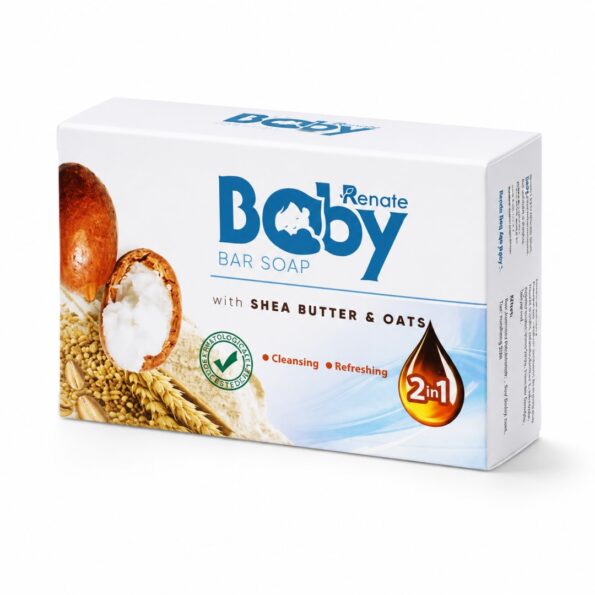
1. Renate Baby Bar Soap — ₵40 (Best for eczema-prone & sensitive skin)
₵40 · 100g · Made in Ghana · 5.0/5 verified
Five ingredients: water, kernel oil, oatmeal, cocoa butter, shea butter. That’s the whole list — and it’s the point. There’s no fragrance to irritate, no parabens, and nothing in the bar that isn’t doing a job.
Oatmeal carries a long-established record for calming itchy, irritated skin, which is why it turns up in eczema care again and again. Shea butter — sourced from the shea belt the factory sits in — replaces the fats that harsh cleansers strip. Cocoa butter holds the moisture in afterwards.
It’s a 2-in-1 bar for face and body, dermatologically tested, and at ₵40 it sits below imported specialist bars while doing the thing those bars are bought for.
The honest trade-off: it costs more than a mass-market bar. If your baby’s skin is trouble-free and price is the deciding factor, you don’t need this. If bath time causes flare-ups, this is what you’re paying for.
2. Johnson’s Baby Soap — the default
The bar most Ghanaian parents grew up on, stocked in every pharmacy and market in the country. It’s cheap, available everywhere, and perfectly adequate for babies with no skin sensitivities. The catch is fragrance — the classic baby smell is added perfume, and on eczema-prone or reactive skin that’s exactly what you’re trying to remove. Fine as a default; not the choice for a flare-up.
3. Cussons Baby Mild & Gentle — milk & chamomile
Cussons markets its Mild & Gentle soap on milk and chamomile extracts to soothe and nourish baby skin, and it’s one of the most widely available options in Ghana. Same profile as Johnson’s overall: affordable, easy to find, generally fragranced. A reasonable everyday bar for untroubled skin.
4. Sebamed Baby Cleansing Bar — the clinical option
Sebamed’s 100g cleansing bar is genuinely well-engineered: soap-free, pH-balanced at 5.5 to support the developing acid mantle, with a moisturising complex built around wheat germ, vitamin E and amino acids plus panthenol. It’s a serious product with a real following among parents of eczema-prone babies.
Two things to weigh. First, it’s a synthetic-detergent bar with a long ingredient list that includes talc and parfum — so it isn’t fragrance-free, and it’s the opposite philosophy to a short natural list. Second, in Ghana it’s an import: pricing runs well above local bars, stock is patchy, and you’re buying through specialist baby shops or marketplaces. If a clinical pH-balanced formulation is your priority and budget isn’t, it’s a strong pick.
5. Cetaphil Baby Mild Bar — soap-free with shea
Cetaphil’s baby bar is soap-free, pH-balanced at 5.5, paraben-free and mineral-oil-free, enriched with shea butter, olive oil and avocado oil, and dermatologist-tested. On formulation it’s arguably the strongest of the imports — it bridges the natural and clinical approaches. The same caveats apply: import pricing and local availability. Worth it if you can find it and the cost doesn’t bother you.
What about “baby soap for glowing skin”?
It’s one of the most searched baby-soap phrases in Ghana, so it’s worth answering plainly. Healthy baby skin looks bright because it’s well-moisturised and not inflamed — that’s all “glow” is. A fragrance-free bar that doesn’t strip the barrier, followed by an oil while the skin is still damp, gets you there.
What no parent should use is a product promising to lighten or whiten a baby’s skin. Skin-lightening agents are not appropriate for babies, and this is regulated territory in Ghana: the Food and Drugs Authority banned hydroquinone in cosmetics, requiring products on the Ghanaian market to be free of it, and it screens products marketed for whitening, lightening, brightening or toning through its Quality Control Laboratory. If a baby product markets itself on making skin fairer, that’s a reason to put it down.
Our verdict
- Eczema-prone, rash-prone or sensitive skin, on a Ghanaian budget: Renate Baby Bar Soap — ₵40, fragrance-free, five ingredients, made here.
- Trouble-free skin, cheapest option: Johnson’s or Cussons at ~₵18–35.
- Clinical pH-balanced formulation, budget no object: Cetaphil Baby Mild Bar, if you can find it locally.
Frequently asked questions
What is the best baby soap in Ghana?
For eczema-prone, rash-prone or sensitive baby skin, Renate Baby Bar Soap (₵40, 100g, made in Ghana) is the best local option — fragrance-free, paraben-free, dermatologically tested, and built on shea butter, oatmeal and cocoa butter with only five ingredients. For babies with no skin issues, mass-market bars like Johnson’s or Cussons (₵18–35) are cheaper and widely available. Imported bars like Sebamed and Cetaphil are well-formulated but cost more and are harder to find locally.
Which baby soap is best for eczema?
Look for fragrance-free first — fragrance is a leading irritant on eczema-prone skin. Then look for ingredients that soothe and restore moisture: oatmeal is long-established for calming itch, and shea and cocoa butter help rebuild what flare-ups strip away. Renate Baby Bar Soap combines all four. A soap supports the skin barrier but isn’t medicine; see a paediatrician or dermatologist for diagnosed eczema or a persistent flare.
Is fragrance-free really better for babies?
For sensitive and eczema-prone skin, yes — fragrance is among the most common causes of contact irritation and contributes nothing to cleaning. For babies with no sensitivities it’s less critical, but there’s no downside to leaving it out. Watch the wording: “unscented” can still contain masking fragrance, while “fragrance-free” means none was added.
How much does baby soap cost in Ghana?
Mass-market baby bars typically sell for around ₵18–35 in Accra markets and pharmacies. Renate Baby Bar Soap is ₵40 for 100g direct from the manufacturer. Imported specialist bars from Sebamed or Cetaphil cost considerably more and vary by seller and stock.
Can baby soap be used on a newborn?
A soap formulated for babies can be used on newborns, including the dry, flaky skin common in the first weeks. Use a mild fragrance-free bar, keep lather away from the eyes, rinse with clean lukewarm water, and pat rather than rub dry. Check with your paediatrician if your newborn has a specific skin condition.
Bar soap or liquid baby wash — which is better?
Neither is automatically better; the formulation matters far more than the format. A well-made fragrance-free bar beats a fragranced wash for sensitive skin, and vice versa. Bars tend to cost less per wash and produce less packaging waste; liquids are easier to use one-handed with a slippery baby.
How often should I bathe my baby?
For most babies, two to three baths a week is plenty in the early months — daily bathing can dry the skin out, especially during harmattan. Top-and-tail in between. If you do bathe daily because of heat, a non-stripping fragrance-free soap matters more, not less.
- American Academy of Dermatology — How to treat eczema in babies (prevalence; fragrance-free cleanser guidance)
- American Academy of Dermatology — Atopic dermatitis: self-care (bathing technique)
- American Academy of Dermatology — Bathing to relieve itchy eczema (colloidal oatmeal)
- Graphic Online — FDA bans hydroquinone (Ghana FDA regulation of skin-lightening cosmetics)
Written and published by Renate Cosmetics, the Ghanaian manufacturer of Renate Baby Bar Soap — one of the products compared above. Competitor formulation details are taken from the manufacturers’ own published product information. All prices, including our own, are correct as at July 2026 and change over time — competitor figures are indicative Accra market ranges, and the current Renate price is always the one shown on the product page. This article is general information, not medical advice. If your baby has diagnosed eczema, a persistent rash or broken skin, consult a paediatrician or dermatologist.