

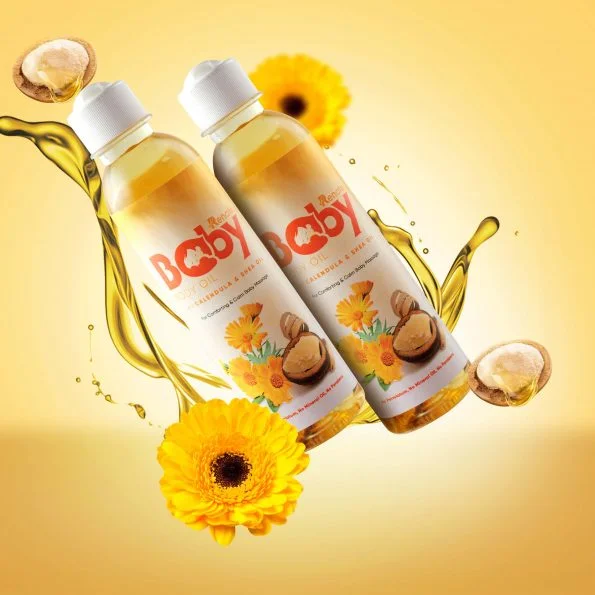
Two things most Ghanaian mums are never told: the best-known baby oils on the shelf are made from petroleum, and the oil your aunties swear by — olive oil — has been shown in published research to damage a baby’s skin barrier. Here’s what’s actually in each bottle, what the evidence says, and what to buy.
Why use a baby oil at all?
Three reasons, and they’re worth separating because the right oil depends on which one you’re solving for:
- Massage. Baby massage is deeply embedded in Ghanaian practice, and it needs slip — something for your hands to glide on.
- Dry skin. Harmattan strips moisture out of a baby’s skin for months at a time. An oil after the bath slows that water loss.
- Hair and scalp. Softening a baby’s hair so a comb doesn’t turn into a fight.
A newborn’s skin barrier is still forming through the first year, which is why what you put on it matters more than it would on you.
The three kinds of baby oil in Ghana
1. Mineral oil bottles
This is what most of the famous names are. Mineral oil is a clear, cheap by-product of petroleum refining, thinned and usually perfumed. Johnson’s and Cussons baby oils are both mineral-oil based.
2. Plant oil bottles
Made from actual seeds and nuts — sunflower, almond, shea. These cost more to make. Renate and Mustela sit here.
3. Whatever’s in the kitchen
Olive oil, coconut oil, shea butter. Free, familiar, and passed down. This is where the research gets uncomfortable.
What the research actually says
This is the part nobody selling baby oil wants to write, so here it is straight.
Olive oil damages the skin barrier
It’s the most commonly recommended oil for babies in Ghana, and that recommendation doesn’t survive contact with the evidence. In a study published in Pediatric Dermatology, researchers applied olive oil to one forearm and sunflower seed oil to the other, twice daily for four weeks. Olive oil significantly reduced skin barrier integrity and caused mild redness — in people with and without a history of eczema. The authors concluded that using olive oil for dry skin and infant massage should be discouraged.
If you take one thing from this article and buy nothing: stop putting olive oil on your baby.
Sunflower oil has the best evidence of any oil
In the same study, sunflower seed oil did the opposite — it preserved barrier integrity, caused no redness, and improved hydration. The reason is linoleic acid, which sunflower oil is rich in and olive oil isn’t; linoleic acid is a building block the skin barrier actually uses.
The effect goes further than comfort. In a community trial of 995 newborns in Nepal, sunflower seed oil massage was compared against the local standard of mustard oil, and hospital studies in preterm infants have linked sunflower oil applications to better skin condition, fewer hospital-acquired infections and improved survival.
The honest caveat — and it matters. A University of Manchester trial followed 115 newborns and found that, compared with using no oil at all, both olive oil and sunflower oil impeded the development of the skin barrier over the first 28 days.
So the fair reading is this: in the first few weeks, the best thing for a newborn’s barrier may be no oil at all. After that — for massage, for dry skin, for hair, for all the reasons families actually use oil — the evidence points to sunflower seed oil as the best-evidenced choice, and to olive oil as the one to avoid. As one dermatologist summarising the field put it, if you’re going to use an oil, sunflower seed oil is the one with better evidence behind it.
That’s the standard we judged these bottles against.
The comparison at a glance
| Renate Baby Deluxe Oil | Johnson’s Baby Oil | Cussons Baby Oil | Mustela Baby Oil | |
|---|---|---|---|---|
| Price | ₵109 | ~₵40–70 | ~₵18–25 | ~₵230 |
| Size | 250ml | ~200ml | 200ml | ~100ml |
| Per 100ml | ~₵44 | ~₵20–35 | ~₵11 | ~₵230 |
| Oil base | Sunflower, shea, almond | Mineral oil | Mineral oil | Plant-based |
| Free of petrolatum | ✓ Yes | Petroleum-derived | Petroleum-derived | ✓ Yes |
| Fragrance | None added | Signature fragrance | Chamomile-scented | Lightly scented |
| Vitamin E | ✓ Yes | No | No | Varies |
| EDTA free | ✓ Yes | Varies | Varies | Varies |
| Made in Ghana | ✓ Yes | Multinational | Multinational | Imported (France) |
Prices are indicative Accra market ranges as listed in July 2026 and vary by seller and bottle size. Check current listings before comparing.
1. Renate Baby Deluxe Oil — ₵109 (Best overall)
₵109 · 250ml · ~₵44/100ml · Made in Ghana · 5.0/5 from 13 verified reviews
Sunflower oil, shea oil, almond oil, Vitamin E, marigold petals. That’s the list — and the first ingredient is the one with the best evidence behind it.
Sunflower oil brings the linoleic acid that the barrier research points to. Shea oil — the fraction of shea that stays liquid — softens without the heaviness, and comes from the shea belt the factory sits in. Almond oil gives the slip a proper massage needs. Vitamin E conditions and keeps the oils fresh. Marigold (calendula) is the classic gentle botanical for delicate skin — and there’s a real petal floating in every bottle, which is a claim you can check with your eyes rather than take on trust.
The label commits in writing: Paraben Free · Mineral Oil Free · EDTA Free. No added fragrance. It works as a body oil, a massage oil and a hair-and-scalp oil.
The honest trade-off: it costs more than the mineral-oil bottles. Plant oils cost more than petroleum by-products — that’s the whole reason. But against the only other plant-based option here, it’s about a fifth of Mustela’s price per 100ml, in the biggest bottle of the four.
2. Johnson’s Baby Oil — the default
The bottle almost every Ghanaian parent grew up with, stocked in every pharmacy and market in the country, and widely used for massage and for cradle cap. It’s cheap, it’s everywhere, and it does seal moisture in.
But read what it is: a mineral oil formula — petroleum-derived — with a signature added fragrance. Two things follow. First, it’s occlusive and nothing else: it forms a film that slows water loss but contributes no fatty acids, no vitamins, nothing the skin can use. Second, that famous baby smell is added perfume, and fragrance is a common irritant on sensitive and eczema-prone skin.
Verdict: fine as a cheap barrier oil for a baby with untroubled skin. Not the choice if you want the oil to do something.
3. Cussons Baby Oil — the cheapest
Cussons sells “Mild & Gentle” (blue) and “Soft & Smooth” (pink), infused with chamomile, and at roughly ₵11 per 100ml it is comfortably the cheapest way to put oil on a baby in Ghana. It’s honest about what it is, too — the product description describes it as a pure mineral oil that adds moisture.
Same analysis as Johnson’s: petroleum base, scented, seals but doesn’t feed. If budget is genuinely the deciding factor, this is the value pick and there’s no shame in it.
4. Mustela Baby Oil — the premium import
Mustela is a serious French baby-care brand with a genuine following: plant-based, hypoallergenic, dermatologically tested, and formulated for newborns. On formulation philosophy it’s the closest thing here to Renate.
The problem is arithmetic and logistics. At around ₵230 for a 100ml bottle it’s roughly ₵230 per 100ml — over five times Renate’s ~₵44 — and it’s an import, so stock is patchy and you’re buying through specialist baby shops or marketplaces. If budget is no object and you can find it, it’s a good oil. Most Ghanaian families are being asked to pay a lot for the privilege of a plant base they can get locally.
What about coconut oil?
It comes up constantly, and it isn’t a bad answer. Pure, cold-pressed coconut oil is single-ingredient, free of added fragrance, and cheap and available everywhere in Ghana. Plenty of paediatricians are comfortable recommending it for exactly those reasons.
Two honest limitations. It’s largely lauric and other saturated fats rather than the linoleic acid that the barrier evidence points to — so it’s not the same thing as sunflower oil, and it’s more occlusive. And it solidifies at Ghanaian indoor temperatures some months and melts others, which makes a consistent massage oil awkward.
Bottom line: if you’re choosing between coconut oil and olive oil, choose coconut oil without hesitating. If you want the best-evidenced base for a baby, that’s sunflower.
What about “baby oil for glowing skin”?
It’s one of the most searched baby-oil phrases in Ghana, so let’s answer it plainly. A baby’s skin looks bright and healthy when it is well-moisturised and not inflamed. That’s all “glow” is. A plant oil applied after the bath while the skin is still slightly damp gets you there.
What no parent should buy is anything promising to lighten, whiten or tone a baby’s skin. Skin-lightening agents are not appropriate for babies, and this is regulated territory in Ghana — the Food and Drugs Authority banned hydroquinone in cosmetics and screens products marketed for whitening, lightening or toning. If a baby product sells itself on making skin fairer, put it down.
Our verdict
- Best overall, and best for massage, dry skin and hair: Renate Baby Deluxe Oil — ₵109, 250ml, sunflower-based, mineral oil free, made in Ghana.
- Cheapest: Cussons Baby Oil, ~₵11/100ml — mineral oil, but honest about it.
- Best premium formulation, if money is no object: Mustela — if you can find it and don’t mind paying roughly five times more per 100ml.
- Best free option: pure coconut oil from your kitchen.
- Avoid: olive oil on babies. The research is clear enough.
- For the first few weeks of a newborn’s life: consider no oil at all, and ask your midwife or paediatrician.
Frequently asked questions
What is the best baby oil in Ghana?
For massage, dry skin and baby’s hair, Renate Baby Deluxe Oil (₵109, 250ml, made in Ghana) is the best pick — a sunflower, shea and almond blend with Vitamin E, mineral oil free, paraben free and EDTA free. Sunflower oil has the strongest evidence base of any oil used on babies. Johnson’s (₵40–70) and Cussons (₵18–25) are cheaper but mineral-oil based. Mustela is a good plant-based import at roughly five times the price per 100ml.
Is mineral oil bad for babies?
No — and it’s worth being accurate about this. Cosmetic-grade mineral oil is considered safe, and it’s genuinely effective at forming a barrier that slows water loss. The honest criticism isn’t that it’s dangerous; it’s that it’s inert. It has no fatty acids and no vitamins, so it seals the skin without feeding it. Plant oils do both jobs, which is why they cost more.
Can I use olive oil on my baby?
The evidence says don’t. A Pediatric Dermatology study found olive oil significantly reduced skin barrier integrity and caused mild redness, in people with and without a history of eczema, and the authors specifically recommended against using it for dry skin and infant massage. It’s one of the most common pieces of advice passed down in Ghana, and it’s one of the few worth ignoring.
What’s the best baby oil for a newborn?
Honestly? In the first few weeks, possibly none. A University of Manchester trial of 115 newborns found that both olive and sunflower oil impeded skin barrier development compared with using no oil over the first 28 days. Ask your midwife. Once you are past that stage and using an oil for massage or dry skin, sunflower-based is the best-evidenced choice.
Which baby oil is best for hair?
A light plant oil that absorbs rather than sitting on top. Renate Baby Deluxe Oil works on hair and scalp as well as body — sunflower and almond soften the hair enough to make combing easier, and shea oil conditions without weighing it down. Mineral-oil bottles coat the hair rather than conditioning it.
How much does baby oil cost in Ghana?
Cussons Baby Oil runs about ₵18–25 for 200ml and Johnson’s about ₵40–70 depending on bottle size — both mineral oil. Renate Baby Deluxe Oil is ₵109 for 250ml (~₵44 per 100ml), plant-based and made in Ghana. Imported Mustela is around ₵230 for 100ml. Prices vary by seller and change over time.
Can adults use baby oil?
Yes, and plenty do — it’s one of the most searched questions about baby oil. A sunflower, shea and almond blend with Vitamin E is simply a good body and hair oil at any age. The only thing to know is that mineral-oil bottles will sit on your skin rather than absorb, which is why some people find them greasy.
When should I apply baby oil?
Right after the bath, while the skin is still slightly damp — that’s when an oil traps the most moisture. Pat baby dry rather than rubbing, then apply. For massage, any calm moment works; many families do it before bed.
- Danby SG et al. — Effect of olive and sunflower seed oil on the adult skin barrier: implications for neonatal skin care, Pediatric Dermatology (2013)
- University of Manchester — Olive and sunflower oil on baby skin weakens natural defences (the ObSeRvE newborn trial)
- Impact of sunflower seed oil versus mustard seed oil on skin barrier function in newborns — community-based cluster-randomized trial (Nepal), via PubMed Central
- Dermatology Times — What we know today about applying oils to newborn skin
- Graphic Online — FDA bans hydroquinone (Ghana FDA regulation of skin-lightening cosmetics)
Written and published by Renate Cosmetics, the Ghanaian manufacturer of Renate Baby Deluxe Oil — one of the products compared above. Competitor formulation details are taken from the manufacturers’ own published product information. All prices, including our own, are correct as at July 2026 and change over time; competitor figures are indicative Accra market ranges, and the current Renate price is always the one shown on the product page. This article is general information, not medical advice. Research findings are summarised in good faith and individual studies have limitations — follow the source links for the full picture. If your baby has a diagnosed skin condition, broken skin or a persistent rash, consult a paediatrician.