

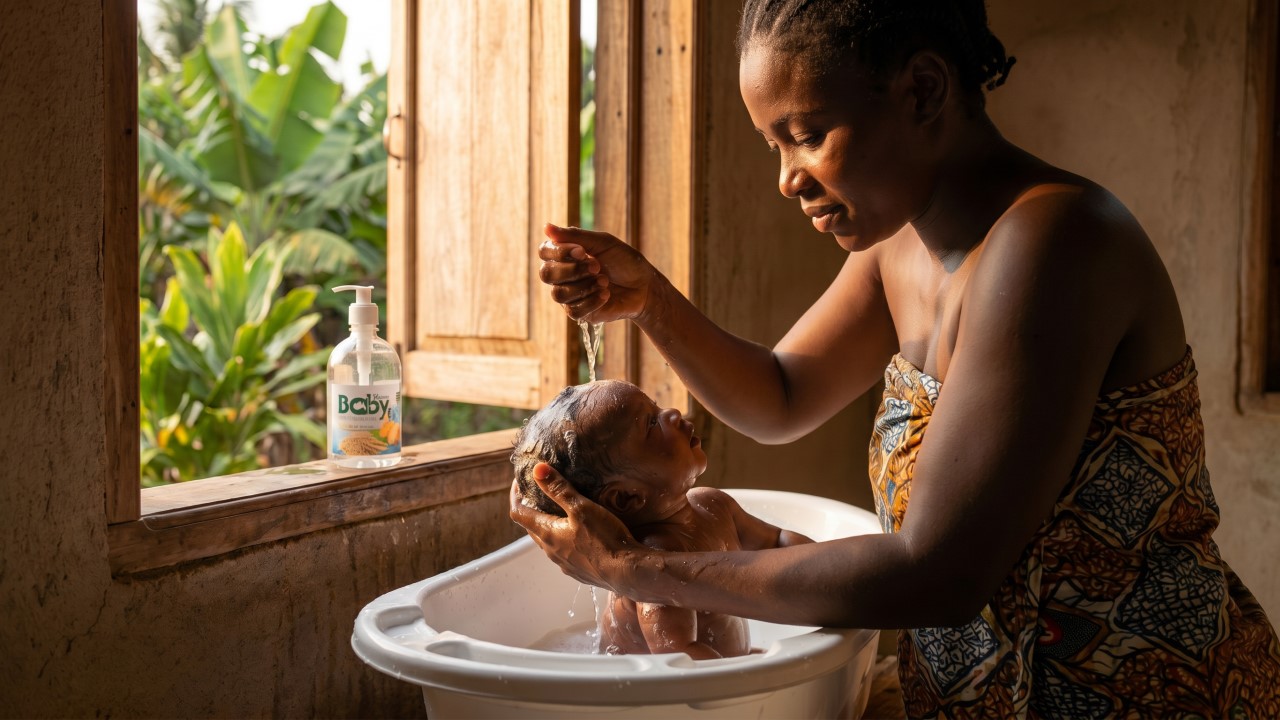
Why Your Baby’s Scalp Is Nothing Like Yours
The natural baby shampoo benefits conversation starts with one simple truth: your baby’s skin is not a smaller version of yours. It is fundamentally different — and it demands a completely different kind of care.
- Why Your Baby’s Scalp Is Nothing Like Yours
- What’s Actually Inside Regular Shampoo — And Why It Matters
- 5 Proven Natural Baby Shampoo Benefits for Your Baby’s Hair and Scalp
- How Ghana’s Climate Makes the Right Shampoo Even More Important
- The Renate Baby Wash & Shampoo: Gentle Cleansing, Naturally
- Frequently Asked Questions About Natural Baby Shampoo
At birth, a baby’s skin barrier is still developing. The stratum corneum — the outermost protective layer of the skin — is thinner and more permeable in newborns than in adults. This means that whatever you apply to your baby’s scalp and skin is absorbed more readily into their body.
The scalp in particular is highly vascular, meaning it has a rich blood supply close to the surface. Harsh ingredients don’t just sit on top — they can penetrate and enter the bloodstream faster than you’d expect.
According to the World Health Organization, protecting infant health in the earliest months of life is critical to long-term wellbeing. That protection extends beyond feeding — it includes every product that touches your baby’s delicate skin.
This is why choosing the right shampoo isn’t a matter of preference. It’s a matter of health.
What’s Actually Inside Regular Shampoo — And Why It Matters
Most adult and even some so-called “baby” shampoos sold in Ghanaian markets contain ingredients that are far too aggressive for a newborn’s scalp. Here’s what to watch out for.
Sulfates (SLS and SLES)
Sodium Lauryl Sulfate and Sodium Laureth Sulfate are foaming agents that strip the scalp of its natural oils. In adults, this can cause dryness. In babies, it can disrupt the fragile skin barrier entirely, leading to irritation, redness, and flaking.
Parabens
Used as preservatives, parabens (methylparaben, propylparaben, butylparaben) have been flagged for their potential to disrupt hormonal activity. Given how permeable infant skin is, this is a real concern — not a marketing myth.
Synthetic Fragrances
The word “fragrance” on a label can hide dozens of undisclosed chemicals. Many of these are common allergens. Babies have no tolerance built up to these compounds, making reactions — rashes, redness, watery eyes — far more likely.
Formaldehyde-Releasing Preservatives
Ingredients like DMDM Hydantoin and Quaternium-15 slowly release formaldehyde as a preservative mechanism. Even at low concentrations, these are classified as potential carcinogens and skin sensitisers by dermatological authorities.
The American Academy of Pediatrics (AAP) consistently advises parents to choose fragrance-free, gentle formulations for newborn care. This advice aligns perfectly with the case for natural baby shampoo benefits.
5 Proven Natural Baby Shampoo Benefits for Your Baby’s Hair and Scalp
Understanding what makes a natural formulation better is empowering. Here are five specific, evidence-backed natural baby shampoo benefits that make a real difference.
1. Preserves the Scalp’s Natural Moisture Balance
Natural shampoos are formulated with gentle, plant-derived cleansers — such as decyl glucoside or coco-glucoside — that lift dirt and excess oil without stripping the scalp’s protective lipid layer. Your baby’s scalp stays clean without becoming tight or dry.
2. Reduces the Risk of Skin Irritation and Allergic Reactions
By eliminating synthetic fragrances, sulfates, and parabens, natural formulations dramatically reduce the contact allergens your baby is exposed to at bath time. For babies with melanin-rich skin — common across Ghana and West Africa — inflammation can leave hyperpigmented patches that take months to fade. Prevention is always better.
3. Safe If It Gets Into the Eyes
Tear-free natural baby shampoos use pH-balanced formulas that match the natural pH of a baby’s tears (around 7.0). This means that even if shampoo runs down into your baby’s eyes during a rinse, there is no stinging, no burning, and no distress. Bath time becomes a joy, not a battle.
4. Supports Healthy Hair Follicle Development
The first two years of life are critical for hair follicle health. Gentle, nourishing botanical ingredients — like shea butter, chamomile extract, or aloe vera — help keep the scalp supple and follicles unclogged. This creates the right environment for healthy hair growth without chemical interference.
5. Fewer Chemicals Absorbed Through Permeable Skin
Because infant skin absorbs topical products at a higher rate than adult skin, every ingredient in a baby shampoo effectively becomes something your baby is exposed to systemically. Choosing a formula free from harsh synthetics means you’re minimising your baby’s overall chemical load — an important consideration for long-term health.
How Ghana’s Climate Makes the Right Shampoo Even More Important
Choosing the right baby shampoo in Ghana isn’t just about ingredients — it’s also about environment. Ghana’s climate presents two distinct challenges for baby scalp health.
During the rainy and humid seasons, babies sweat more around the scalp and hairline. This excess moisture, combined with a harsh shampoo, can strip natural oils and create conditions where fungal issues like cradle cap worsen. A gentle, pH-balanced natural shampoo cleanses without over-drying — keeping the scalp microbiome balanced even when it’s hot.
During harmattan season, the dry, dusty winds from the Sahara reduce ambient humidity dramatically. Baby scalps can become dry and flaky almost overnight. A natural baby shampoo enriched with moisturising botanicals helps the scalp retain hydration between washes — something a sulfate-heavy formula simply cannot do.
Babies with naturally coily or kinky hair textures — common across Ghana and Francophone West Africa — also benefit from the added conditioning properties of plant-based formulas. These textures are naturally drier, and preserving every drop of moisture at wash time matters.
The Renate Baby Wash & Shampoo: Gentle Cleansing, Naturally
If you’re looking for a natural baby shampoo that was formulated with Ghanaian babies in mind, the Renate Baby Wash & Shampoo is designed to deliver exactly that.
It’s a gentle 2-in-1 cleanser that washes both baby’s body and hair in one step — without stripping natural moisture. It is tear-free and pH-balanced to match the delicate chemistry of newborn skin, making it safe from day one. The formula is free from harsh sulfates, parabens, and synthetic fragrances, so you get all the natural baby shampoo benefits without compromise.
After bath time, locking in that clean, fresh moisture is just as important as the wash itself. The Renate Baby Lotion pairs perfectly with the wash — a lightweight, fast-absorbing daily moisturiser formulated with shea butter and gentle botanical oils to keep baby’s skin soft and nourished all day. Together, they form a complete, fuss-free bath and body routine built specifically for Ghanaian babies.
Both products are manufactured right here in Ghana, using natural ingredients your family can trust — including the shea butter that West African mothers have used for generations to nourish and protect their children’s skin.
Frequently Asked Questions About Natural Baby Shampoo
What are the main natural baby shampoo benefits compared to regular shampoo?
Natural baby shampoos are free from sulfates, parabens, and synthetic fragrances that can irritate a baby’s sensitive scalp. The key natural baby shampoo benefits include gentler cleansing, better moisture retention, reduced risk of allergic reactions, and a lower overall chemical load — which matters because infant skin absorbs ingredients more readily than adult skin.
At what age can I start using baby shampoo on my newborn?
You can use a gentle, tear-free natural baby shampoo from birth. Newborns don’t need daily hair washing — two to three times per week is usually sufficient. Always use lukewarm water and rinse thoroughly to prevent any residue on the scalp.
Is natural baby shampoo good for cradle cap?
Yes. Gentle natural formulas help keep the scalp clean without over-drying, which is important for managing cradle cap (seborrhoeic dermatitis in infants). Avoid scrubbing or picking at the flakes. A soft brush after washing can gently loosen them. If cradle cap persists or worsens, consult a paediatrician.
Can I use adult natural shampoo on my baby?
No. Even adult shampoos marketed as “natural” are formulated for the pH of adult skin (around 5.5), which is more acidic than baby skin. Baby skin has a near-neutral pH closer to 7.0. Using an adult formula — even a natural one — can disrupt the baby’s acid mantle and leave their scalp vulnerable to bacteria and irritants.
How often should I wash my baby’s hair in Ghana’s hot climate?
In Ghana’s humid weather, especially during the rainy season, washing your baby’s hair two to three times per week is generally appropriate. During harmattan, once or twice a week may be sufficient to avoid over-drying an already parched scalp. Always follow the wash with a gentle moisturiser to seal in hydration.
Are natural baby shampoos tear-free?
Most quality natural baby shampoos are formulated to be tear-free by matching the pH of a baby’s tears. The Renate Baby Wash & Shampoo, for example, is both pH-balanced and tear-free, making it safe even if suds reach your baby’s eyes during rinsing.
What ingredients should I look for in a natural baby shampoo?
Look for plant-derived surfactants like decyl glucoside or coco-glucoside, soothing botanicals like aloe vera or chamomile extract, and nourishing butters such as shea butter. Avoid anything listing SLS, SLES, parabens, DMDM Hydantoin, or “fragrance” as an ingredient without further disclosure.