

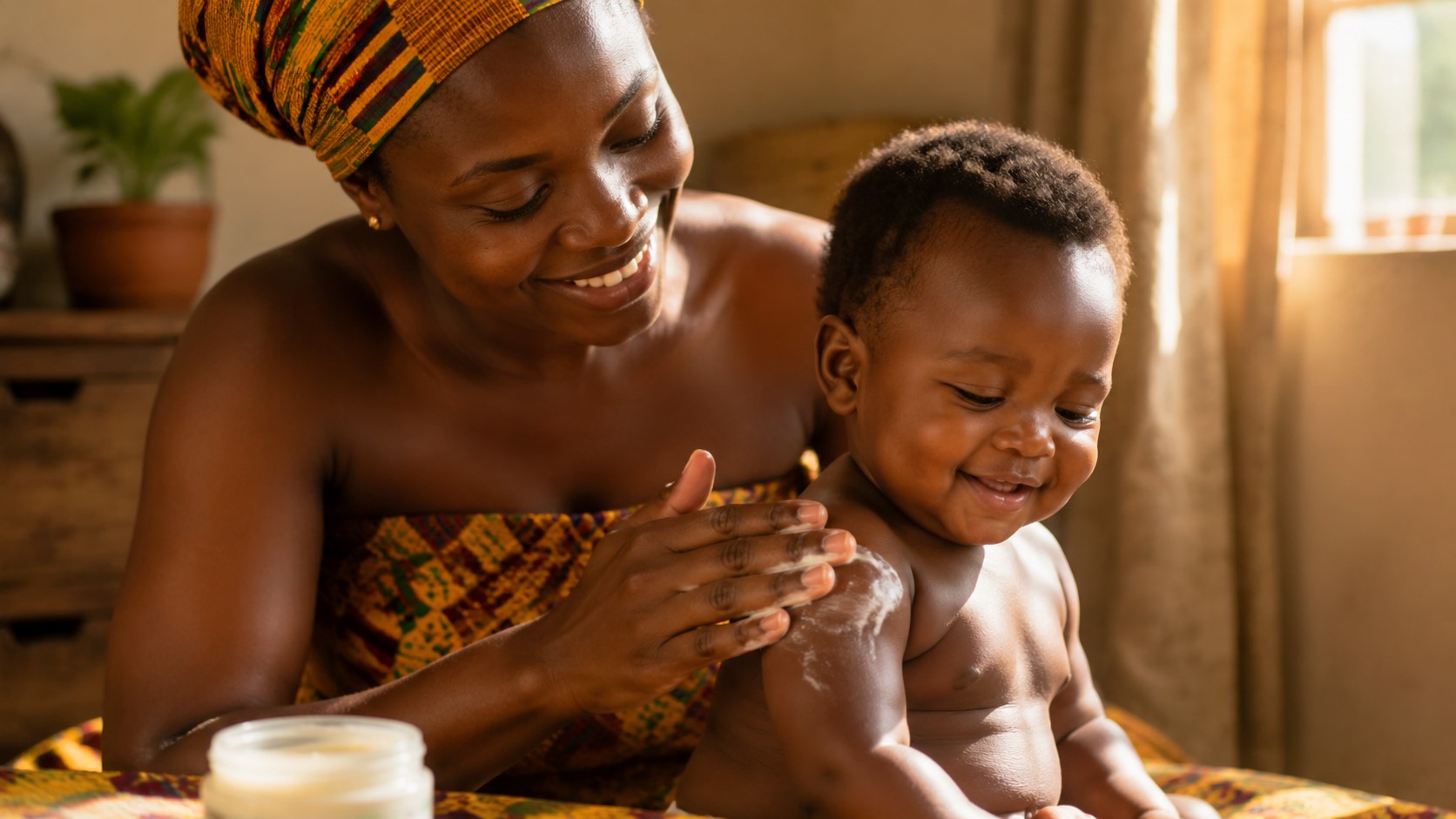
Why Shea Butter Has Always Been a Baby Skin Essential in West Africa
The shea butter baby skin benefits are not a modern discovery — Ghanaian and West African mothers have known about them for centuries. Long before clinical trials and cosmetic laboratories, women across the Sahel and the forest belt were reaching for nkuto — raw shea butter — to protect their newborns from the elements.
- Why Shea Butter Has Always Been a Baby Skin Essential in West Africa
- The Top 5 Shea Butter Baby Skin Benefits, Explained by Science
- Whipped vs. Raw Shea Butter — Which Is Better for Your Baby?
- How to Use Whipped Shea Butter on Baby Skin Safely
- The Best Renate Products for Your Baby’s Shea Butter Routine
- Frequently Asked Questions About Shea Butter and Baby Skin
And the elements here are no joke. Ghana’s climate swings between two extremes that are particularly harsh on baby skin. During the hot, humid rainy season, sweat and friction cause rashes and irritation. Then comes the harmattan — that dry, dusty northeastern wind that rolls in between November and March — stripping moisture from even the most well-hydrated skin. For a baby’s delicate skin barrier, which is 30% thinner than adult skin, these conditions demand serious protection.
Shea butter, derived from the nut of the Vitellaria paradoxa tree native to the West African savannah, is perfectly suited to this climate. It is rich in the exact fatty acids and bioactive compounds baby skin needs to stay soft, protected, and healthy — all year round. This guide breaks down the science behind those benefits and shows you how to use whipped shea butter safely and effectively on your baby.
The Top 5 Shea Butter Baby Skin Benefits, Explained by Science
Understanding shea butter baby skin benefits means looking closely at what is actually inside shea butter — because every benefit traces back to a specific compound.
1. Deep, Long-Lasting Moisturisation
Shea butter is packed with oleic acid (40–60%) and stearic acid (20–50%) — two fatty acids that closely mimic the skin’s own natural lipids. This allows shea butter to penetrate the outer skin layers and replenish moisture from within, rather than simply sitting on the surface. For babies prone to dry, flaky skin during harmattan, this deep hydration is a game-changer.
2. Strengthens the Skin Barrier
Baby skin loses water rapidly — a process called transepidermal water loss (TEWL). Shea butter forms a breathable, occlusive layer that dramatically slows TEWL, helping to reinforce the skin barrier. The American Academy of Pediatrics recommends emollient-rich moisturisers to support the skin barrier in newborns, particularly those with eczema-prone skin.
3. Natural Anti-Inflammatory Action
Shea butter contains lupeol cinnamate, a triterpene compound with well-documented anti-inflammatory properties. This makes it ideal for soothing nappy rash, heat rash, and the general redness that comes with sensitive melanin-rich baby skin. It calms irritation without the side effects associated with steroid-based creams.
4. Rich in Vitamins A and E
The natural vitamins A and E in shea butter act as antioxidants, protecting baby skin from environmental stressors — including harmattan dust and UV exposure. Vitamin A also supports healthy cell turnover, keeping skin smooth and supple, while Vitamin E works to repair and nourish the skin at a cellular level.
5. Gentle Enough for Newborns
Unlike many commercial baby products that contain parabens, mineral oil, or synthetic fragrance, pure shea butter is naturally free from harsh chemicals. It is non-comedogenic (won’t block pores) and rarely causes allergic reactions, making it one of the safest moisturisers for babies from birth. These combined shea butter baby skin benefits explain why it remains the first-choice ingredient in quality baby care across West Africa.
Whipped vs. Raw Shea Butter — Which Is Better for Your Baby?
Raw, unrefined shea butter is powerful — but it comes with practical challenges. It has a dense, waxy texture that can feel heavy on baby skin, especially in Ghana’s humid climate. It also has a strong, smoky odour that not every parent or baby takes to easily. In cold harmattan conditions, raw shea butter becomes very hard and difficult to apply without pulling at delicate skin.
Whipped shea butter solves all of these problems. The whipping process — which aerates the butter at a controlled temperature — transforms it into a light, fluffy, fast-absorbing cream. Here is why whipped shea butter is often the better choice for babies:
- Lighter texture: Absorbs quickly without leaving a greasy residue — important in Ghana’s humid weather.
- Easier to apply: Soft, spreadable consistency means no tugging or dragging on fragile newborn skin.
- Better blending: The whipping process allows complementary oils — like sweet almond, jojoba, or coconut — to be incorporated for enhanced nourishment.
- More pleasant experience: A whipped formula turns bath and massage time into a soothing ritual your baby will enjoy.
The shea butter baby skin benefits remain fully intact through the whipping process — in fact, when blended with complementary botanical oils, a quality whipped shea butter can deliver even broader nourishment than raw shea alone. The key is choosing a product made without synthetic fillers, preservatives, or artificial fragrance — so those active compounds stay potent and safe.
How to Use Whipped Shea Butter on Baby Skin Safely
Getting the most from the shea butter baby skin benefits is as much about technique as it is about ingredients. Here is a simple, effective routine for Ghanaian parents:
Step 1: Patch Test First
Even natural ingredients can occasionally cause sensitivity. Before first use, apply a small amount of whipped shea butter to the inside of your baby’s elbow. Wait 24 hours and look for any redness or irritation. If the skin looks clear, you are good to go.
Step 2: Apply After a Bath — While Skin Is Still Damp
The best time to moisturise is within three minutes of bathing, while the skin is still slightly damp. This locks in the extra moisture from the water. The NHS recommends applying emollients immediately after bathing for babies with dry or eczema-prone skin to maximise absorption.
Step 3: Use Gentle, Circular Motions
Warm a small amount of whipped shea butter between your palms first, then massage gently into your baby’s skin using small circular strokes. This also stimulates blood circulation and can help your baby relax before sleep.
Step 4: Pay Attention to Dry Zones
Focus on areas that dry out fastest — ankles, knees, elbows, the back of the neck, and the face. During harmattan, you may need to moisturise twice daily. During the humid rainy season, once after bath is usually sufficient.
Step 5: Store Properly
Keep whipped shea butter away from direct sunlight and heat. A cool, shaded spot in your home preserves the texture and prevents the butter from melting and losing its whipped consistency.
The Best Renate Products for Your Baby’s Shea Butter Routine
If you are looking for a trusted, made-in-Ghana product that delivers all the shea butter baby skin benefits in a safe, expertly formulated blend, Renate Cosmetics has you covered.
The hero product for intense moisturisation is the Renate Whipped Baby Butter — a rich, cloud-soft body butter formulated specifically for babies with very dry or sensitive skin. It is packed with high-quality shea butter and carefully selected botanical oils that work together to deeply nourish the skin barrier, soothe irritation, and keep your baby’s skin smooth through both harmattan and humid seasons. If your baby struggles with dryness, eczema-prone patches, or general skin sensitivity, this is the product to start with.
For a complete daily routine, pair it with the Renate Baby Lotion — a lightweight, fast-absorbing daily moisturiser that is perfect for everyday use, especially during Ghana’s warmer months when a heavier butter might feel too rich. It delivers the same core shea butter baby skin benefits in a lighter, everyday-friendly format.
Round out your baby’s routine with the Renate Baby Wash & Shampoo, a tear-free, pH-balanced 2-in-1 cleanser that gently removes dirt without stripping the natural moisture that shea butter and other emollients work so hard to maintain. A gentle cleanse followed by a generous application of whipped shea butter is the gold standard baby bath routine — and now you can do it entirely with products made right here in Ghana.
Frequently Asked Questions About Shea Butter and Baby Skin
Can I use shea butter on a newborn’s skin?
Yes. Pure, unrefined shea butter and quality whipped shea butter formulations are generally considered safe for newborns. Always perform a patch test first and choose products that are free from synthetic fragrance, parabens, and harsh preservatives.
What are the main shea butter baby skin benefits?
The key shea butter baby skin benefits include deep moisturisation, strengthening the skin barrier, reducing inflammation and redness, protecting against environmental dryness (like harmattan), and delivering vitamins A and E to support healthy skin development.
How often should I apply whipped shea butter to my baby?
Once daily after bathing is sufficient for most babies. During harmattan or in air-conditioned environments, twice daily — morning and after bath — is recommended to combat extra dryness.
Is whipped shea butter good for baby eczema?
Yes. The anti-inflammatory compounds in shea butter, particularly lupeol cinnamate, help to calm the redness and itching associated with eczema. Whipped shea butter also reinforces the skin barrier, which is compromised in eczema-prone skin. Always consult your paediatrician if your baby has a confirmed eczema diagnosis.
Can shea butter cause allergies in babies?
Shea butter allergies are rare. Shea comes from the same botanical family as latex, but cross-reactivity is extremely uncommon. If your child has a known tree nut allergy, consult your doctor before use. Otherwise, a simple patch test is all that is needed.
Is whipped shea butter better than raw shea butter for babies?
Whipped shea butter is easier to apply, lighter in texture, and more comfortable on baby skin — especially in Ghana’s climate. Raw shea butter can be too dense and waxy for delicate newborn skin. The shea butter baby skin benefits are fully preserved in a quality whipped formulation.
At what age can I start using shea butter on my baby?
Many parents use shea butter from birth. For the first few weeks, the World Health Organization advises keeping skincare simple and fragrance-free. A pure, additive-free whipped shea butter like Renate Whipped Baby Butter is appropriate from the newborn stage, but always check with your midwife or paediatrician if you have specific concerns.
Conclusion
The shea butter baby skin benefits are deeply rooted in both West African tradition and modern dermatological science. From its barrier-strengthening fatty acids to its natural anti-inflammatory properties, shea butter is one of the most complete and gentle ingredients you can put on your baby’s skin.
For Ghanaian mums navigating the extremes of harmattan and humid heat, a quality whipped shea butter is not a luxury — it is a daily essential. With the right product and a simple consistent routine, your baby’s skin can stay soft, protected, and healthy in every season.
Renate Cosmetics brings you the best of Ghana’s natural ingredients, carefully formulated for the youngest and most sensitive skin. Because your baby deserves nothing less.